How does Clint Bentley’s ‘Train Dreams’ comment on contemporary environmental loss and why is destruction justified?
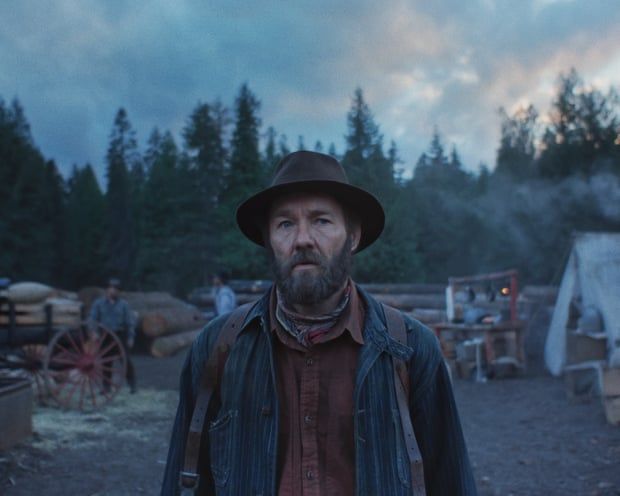
Released globally on Netflix late last year, Train Dreams has remained one of the platforms most hidden gems. Only recently has this film been understood as an important addition to cinema, exploring themes such as grief, isolation and the inevitable clash between the natural world and industrial progression. With subtle yet deep performances from main actors Joel Egerton, playing Robert Grainier and Felicity Jones his wife, Train Dreams transforms into an existential questioning of the meaning of life. By challenging human-centered storytelling with long scenes of quiet landscapes, this film relies cleverly on time, scale and immersion to present ideas of ecological change and exploitation at the hands of society.

The cinematography of Train Dreams allows nature to have narrative authority. By simply reducing dialogue and prioritising landscapes, the environment is not reduced to just a symbol but rather it exists with complexity, history and consequence. Wide shots force the audience to read meaning into forests, weather and terrain just as you would a characters expressions. Nature’s agency can also be seen in its response to human presence. As the film progresses and land becomes increasingly interfered with, sound-design is shaped to demonstrate this change. Wind, animal calls, creaking trees and cracking fire makes audiences hyper-aware of the environmental sounds and remind us that humans are simply part of a much larger system than themselves. This constant reminder of nature as a living presence that can be beautiful and harsh reverses the typical progression of a narrative- the world around the characters shapes their identity rather than vice versa. Work becomes dependant on forests, isolation is intensified by wilderness and even death becomes inseparable from natural events shown by the death of Robert’s wife and child due to a forest fire.

The industrial progress of early 20th century America is displayed as not always destructive and violent but essential. What audiences see as commendable is the exhausting, repetitive and dangerous physical work of the construction workers but nature eventually pushes back. Audiences are shown the consequences of irreversible and incremental environmental change as nature asserts itself through harsh weather, fires and accidents. For example, logging is the films central routine economic activity. As more forest is cut down, centuries of growth is lost in just months and we see more open clearings, stumps and silence where ancient trees once stood. As the characters solely value the forest as a commodity rather than for its ecological role, nature strikes back and William H. Macy’s character is struck down and killed by a falling branch.
Similarly, the railroad construction is, for society, a economic opportunity motivated by the possibility of connecting two parts of land. For the workers they see modernity yet thematically it represents division, human control and the penetration of wilderness. This railroad fundamentally portrays an exploitation rather then co- existence between characters and nature. Robert is riding on the train when he discovers the forest fire that tragically ends his family’s life. In contrary to this, it is harsh to accuse the workers as the ‘evil’ in this scenario. Just as hundreds in history did, Robert is trying to survive in the only economic system available to him. Although his contribution to environmental loss has consequences, the overall impact of his actions is not dramatic but endearing and quiet, echoing our current situation regarding the natural world.

Overall there are five ways to summarise how Train Dreams speaks to contemporary environmental degradation.
Destruction is ‘normalised’
Logging and construction are not framed as exceptional acts of harm but as ordinary. Such normalised labour can be mirrored in present day economic activity such as fossil fuel extraction and industrial agriculture. These acts are accepted within current systems and proves environmental collapse doesn’t need villains. Just an view of productivity over preservation is enough to cause irreversible change.
Incremental loss over dramatic loss
Train Dreams preaches there is no singular moment where the environment is ‘ruined.’ Whilst this film trains the viewers to notice the absence of nature, modern day society struggles to emotionally grasp the destruction of nature as it’s undeniable only in retrospect. More then often the world is faced with dramatic natural loss but day to day such degradation is invisible to the public eye.
Progress erases origin
As mentioned previously, the film’s railroad could of only been constructed by destroying landscape that sustained life. This can be reflected in contemporary urban development and infrastructure only built sole for growth. such practices like ‘green’ technologies that rely on extractive mining leaves future generations disconnected from the natural world.
Human smallness in a damaged world
The characters are reduced to tiny figures in a large environmental landscape. As the narrative progresses, we witness the emotional reality of living inside slow environmental collapse- grief, confusion and resignation engulfs our protagonist the more he loses to natural forces. This mirrors a contemporary feeling of powerlessness in the face of environmental change, that society feels overwhelmed by the consequences of our actions and subsequently refuse to face the issue. Many of the extreme outcomes of events such as climate change with neither occur in our lifetime stirring a disinterest in the general public to take action.
Nature will not always recover from human harm
Much of the globe’s population is under the impression than human life is more fragile than the system it exploits. This can be seen within Train Dreams long, wide shots of the increasingly bare landscape destroyed by fire, logging and human intervention. This human-enforced damage permanently reshaped the American-Northwest’s ecosystem debunked the myth that the natural world will eventually get back on its feet.

I see Train Dreams as a warning. As decades go by, modern day society witnesses a silent acceptance of a more degraded environment. The desensitisation of destruction and collapse has allowed the natural world to become a shell of what once existed. Train Dreams encourages viewers to ask why environmental damage has been justified and challenges us to consider the relentless march of industrial progress and its cost to nature.
It is truly an important film, fuelled by emotional performances and a unique narrative voice-over. Clint Bentley has produced a powerful call for action, he is clearly a director of considerable subtlety yet feeling.
GO WATCH IT !!!!!!!!!!!!!
Leave a Reply